


Where Should Inquiry Forms Live for Maximum Conversion?
Landing pages are a useful and powerful tool for private schools. Living outside of your main website, they have the ability to deliver further brand messaging, offer important additional information, and focus visitors’ attention on a single conversion point. When recruitment campaign traffic lands there, you have an opportunity to turn curious parents into prospects your admissions team can connect with online or in real life.
So where’s the best place to put your ultimate conversion point, the contact form: above the fold or below the fold?
The answer isn’t black and white.
Our web and UX experts can help you figure out what’s best for your specific private school and individual campaign.
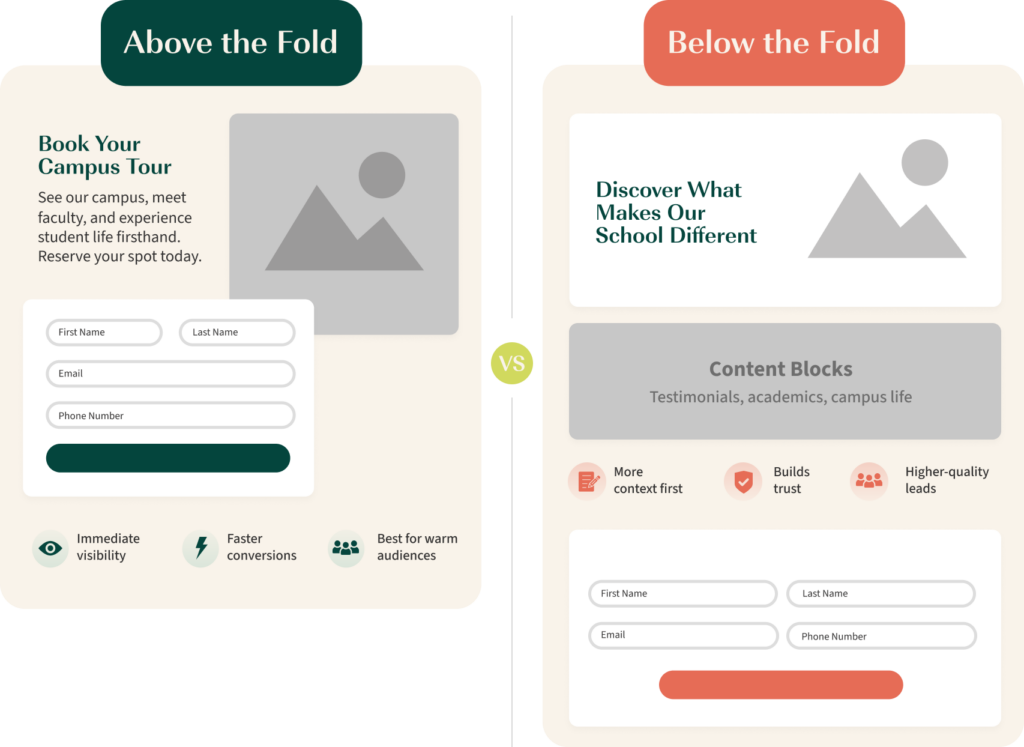
What “Above/Below the Fold” Really Means
A term borrowed from the newspaper industry, “above the fold” refers to the part of a webpage that is visible without scrolling. “Below the fold” means the user must scroll down to locate the conversion point.
There are strong cases to be made for both.
The Argument for Above the Fold
It’s long been a belief that above-the-fold conversion points were the superior choice for landing pages, and for good reason.
The benefits are real:
- Maximum visibility: A form seen immediately gets the most exposure, which is useful if your offer is simple and the visitor’s intent is high.
- Quick action: If visitors already know your school or clicked from targeted traffic (e.g. email/newsletter, Google ads), they may be ready to register instantly.
- Mobile: On small screens, a simple form can be quickly found and then filled out.
As a result of these benefits, conversion points above the fold are very effective for multiple scenarios:
- Clear, low-effort actions like buttons to download brochures or viewbooks
- Short, simple forms that have only a few small fields
Early form placement reduces friction and captures leads before they lose interest, and when part of a cohesive digital strategy, it can help produce a 62% increase in lead form submissions.
The Argument for Below the Fold
While it can feel obvious to choose an above-the-fold layout for your landing page, conversion points that appear below the fold can be just as, if not more, effective.
They have unique advantages of their own:
- Context first: Decisions surrounding their child’s education are important for parents. They’re not made lightly, so a landing page that provides context and confidence before asking for a conversion can be beneficial.
- Higher-quality leads: By the time parents have scrolled through your landing page’s value propositions, testimonials, campus info, etc., they will have a better idea if your school is the right fit, which means when they convert, they’ll be more likely to continue in the funnel.
- Respect the journey: A conversion point that requests personal information or a deliberate action can be seen as overly aggressive if placed above the fold. A lower placement can feel less transactional.
This approach is ideal for a variety of important situations:
- Larger, high-commitment conversions
- Pages targeting cold audiences who don’t yet know your school
It’s something to consider if your goal is to increase recruitment event attendance, and we’ve used it to help deliver a 96% increase in open house registrations and 60% increase in tours.
So, Which Is Better?
Here’s the short answer: it depends.
Your school is unique, and so is your marketing strategy. It’s important to look objectively at what it is you’re trying to accomplish and make the best decision based on those factors. But there are definitely some universal truths that should always play into your decision making.
- Visitors will scroll if the content promises value: Research shows people do scroll. They’ll often scan the entire page if the content they’re met with above the fold is relevant and provides them with value. This means knowing your audience – regardless of whether they’re Gen X or Millennial parents.
- Fields can create friction: If your conversion point is a form, then its layout matters just as much as its location. Forms that have too many fields – or fields that are difficult to populate – will turn away even the most mission-aligned families. Nobody, regardless of how right they are for your school, wants to fiddle with a form for too long.
- Form placement should complement the decision process: UX researchers stress that CTA/form location should match how much information users need before converting – not just aim for maximum initial visibility. So, what are you asking them to do? And how can you make them feel good about doing it?
- Plan your flow: Whether it’s above the fold or below it, your landing page needs to consider UX. For above-the-fold conversion points, make sure the hero image and visible copy both work together and offer value. For below the fold, create a content flow that builds upon itself and leads seamlessly into the conversion point.
Testing Beats Guessing
Assumptions and hunches can lead to incorrect marketing decisions – and that can lead to misallocated budgets.
Data is the best way to know for sure if your strategy is working.
These metrics can be helpful for deciding where to place your conversion point:
- Form completion rate
- Bounce rate
- Scroll depth
A finely tuned landing page can be an immensely important and productive part of your school’s marketing strategy.
In fact, they play a key role in Metric GRO – our proven, comprehensive system for selective and sustainable enrollment.
And our team of seasoned UX, web, and creative experts can help you build, test, and optimize it.
Keep Learning
- Reaching Parents at the Awareness Stage
- Engaging Families in the Familiarity Stage
- Winning at the Conversion Stage
At Metric Marketing, we develop measurable and practical strategies to help private and independent schools like yours to make the most of your marketing efforts. We’d love to discuss your private school’s marketing requirements with you. Contact us today to speak with our marketing professionals or use the form below to sign up and receive more marketing tips in your inbox.


